Zoo Atlanta
The One and Only IvanZoo Atlanta is the destination that changes the terms of Ivan’s life: after years alone in a cage, he can live among other gorillas. Yet the novel does not treat relocation as the same thing as freedom. Its first view of Ivan’s new enclosure is shadowed by uncertainty, and a later walk to the habitat’s high white wall confirms that this new home is still bounded space.
Setting and Physical Environment
In the story, Ivan wakes in a habitat with three glass walls and a fourth wall made from wooden slats strung together. At first, the unfamiliar enclosure offers no reassuring view of a gorilla group. Ivan wonders where the other animals are and whether Ruby has ended up alone in a cage like her old one. The scene makes the move feel incomplete: the new place is not yet legible to him as a home.
The landscape later opens into grass, a hilltop, and a low-limbed tree. Ivan explores the slope at his own pace, feeling the grass against his knuckles and scooping up rain-softened earth. From the hill, however, the boundary is unmistakable: a clean white wall stretches toward habitats beyond his own, built to keep its inhabitants in and others out. The green ground and rich dirt offer forms of contact absent from the mall, but the wall makes clear that a change of setting has not ended confinement.
Transfer and Arrival
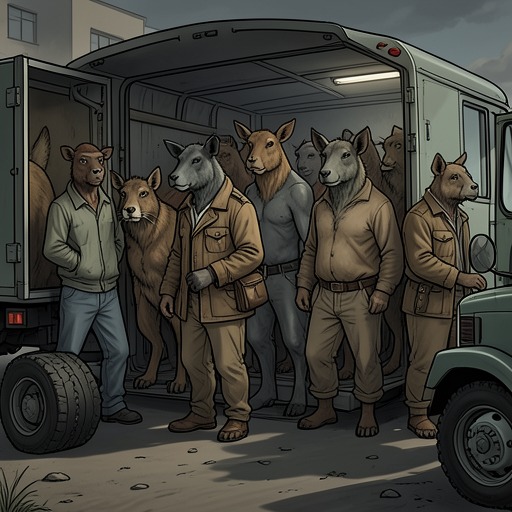
The novel presents the move through a practical sequence of inspection and preparation. A man with a clipboard checks the property, including Ivan’s floor, Ruby’s hay, and the animals’ water bowls. A week later he returns with a woman in a white coat; after she and the inspector speak with Mack, Mack receives a sheet of paper and retreats to his office. When the woman comes back with other people, they place a box sized for Ruby in the ring, and Ivan understands that she is to be taken away.
Ivan’s own transfer follows. He sees men setting a metal box in the ring, then finds the box open and pushed against his doorway, with his cage door propped open as well. The open doorway is therefore not an unambiguous offer of escape: to leave his enclosure, Ivan must enter the transport box. Maya, whom he recognizes as the zoo representative, is present as this threshold is prepared. The move depends on people, paperwork, inspection, and equipment as well as on the animals’ passage from one enclosure to another.
Social Life and the Limits of the New Home
On waking in the new place, Ivan’s first concern is whether other gorillas are there and whether Ruby is safe. His questions register what the move is meant to change: not simply the scenery, but the isolation that has defined his life. The narrative initially withholds confirmation of a gorilla community, letting the unfamiliar enclosure remain a source of anxiety rather than immediate comfort.
The author’s note supplies the real-life outcome behind the fictional journey. The real Ivan lives contentedly at Zoo Atlanta with Kinyani and other gorillas, and the zoo houses the largest group of captive western lowland Gorillas in the nation. That later companionship gives the destination its decisive importance: the zoo can provide a social world that the mall cage did not. It does not, however, erase the distinction between a managed habitat and an unrestricted life beyond walls.
Real-World Context and Significance
The author identifies the novel as fiction inspired by Ivan’s true story. The real Ivan was captured as an infant in what is now the Democratic Republic of the Congo; after being raised in a home, he was moved to a circus-themed mall in Washington state when he became unmanageable. He spent twenty-seven years alone in a cage. As understanding of primate needs grew, public discomfort with that isolation increased, especially after his appearance in a National Geographic special; letters from children formed part of the public outcry. When the mall went bankrupt, Ivan was placed on permanent loan to Zoo Atlanta.
Zoo Atlanta thus stands at the meeting point of an individual relocation and a broader change in how Ivan’s captivity was regarded. In the novel, its habitats offer grass, earth, and the prospect of contact with other gorillas, while the wall remains visible within the landscape. In the real account, the move ends decades without another of his kind. The place matters not because it abolishes captivity, but because it makes companionship possible within it.